Transformation · Energy

The best solar markets had no installation partner in them.

A residential solar company assumed its partner network covered its best markets. Ranking districts on demand showed the strongest ones had no installation partner at all.
Residential solar
Partner and dealer channel
North Indian district
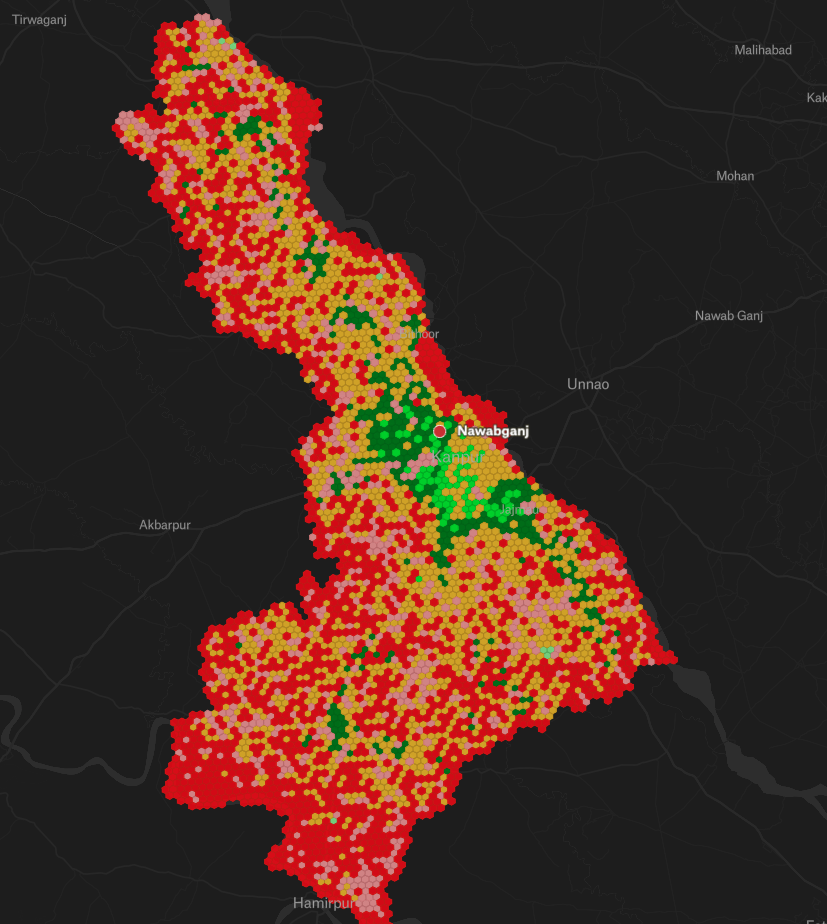
Scored residential markets with unmanned top-ranked areas highlighted

What the district analysis found

The strongest markets in the district were open ground.

9 of 10
Validated
Top-ranked areas with no partner stationed inside them.
7 of 9
Validated
Unmanned areas where customers already exist. Proven demand with no partner to serve it.
81%
Validated
Catchment overlap between the two most closely placed partners.
~938,500
Scope
Households covered by the 2,553 hexagons scored as residential markets.

The case

01 · Demand proven and unserved

Customers buying where nobody has been stationed

Seven of the nine unmanned top-ranked areas already held existing customers. The demand was visible in the company's own installation records and the ground was open.

02 · Partners clustered in one zone

Good individual placements, concentrated coverage

Every partner graded in the 95th percentile or above. Two of them shared 81% of their catchment. Sound decisions made one at a time concentrated the coverage in one zone.

03 · Two products, two geographies

The channel treated as one when the demand splits

Grid-connected systems suit the south-city colonies. Hybrid and solar cooling systems suit the tehsil ring and city fringe. The channel had been recruited as though the product were one.

All partners placed excellently, and the strongest markets still empty

Two measures kept separate. Catchment reach grades a service-led installer. In-area presence grades a walk-in counter. Every partner ranked in the 95th to 99th percentile on reach. The top-ranked markets had no partner inside them at all.

Placement quality
Partner 01
99th pctile
Partner 02
96th pctile
Partner 03
95th pctile
Every partner in the top five per cent of all possible base locations in the district.
Catchment overlap
Partner 03 with 01
81%
Partner 01 unique
32%
Partner 02 unique
23%
The two closest partners share four fifths of their catchment.
Top-ranked areas
Unmanned, with customers
7
Pure whitespace
2
Partnered
1
Nine of ten highest-scoring areas have no partner inside them.

The partners are well placed individually. The network still leaves its strongest markets uncovered. Seven of those markets already have customers buying the product.
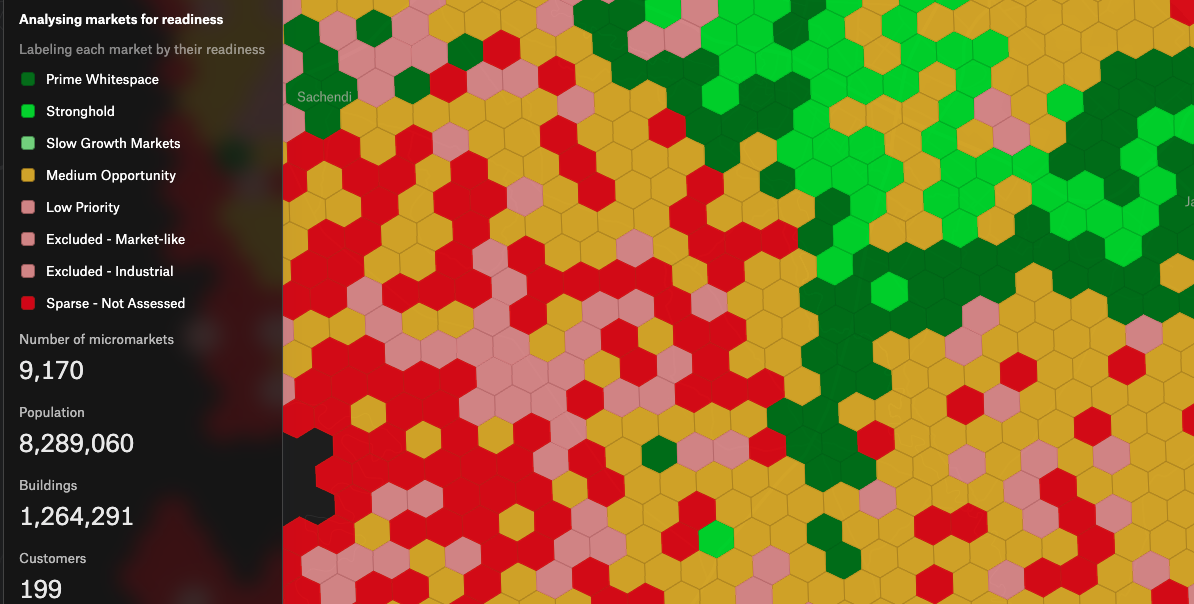
Three service radii over the scored district with unmanned top areas marked

What was scored

Signals chosen for a product installed on a roof and sold to a household.

Suitable roof base

Building footprints filtered to roofs capable of carrying an installation.

The physical ceiling on how many systems a market can take, which no demographic measure captures.

Wealth markers

Affluence proxies at hexagon level, applied as a gate for premium product.

Hybrid and solar cooling systems carry a higher ticket, so the market has to clear an affordability threshold.

Arterial road proximity

Distance from each area to a main road.

Installation and after-sales service both depend on physical access, which decides whether a market can be served at all.

Existing customers, geocoded

The company's own installed base placed onto the hexagon grid.

Separates areas with proven demand from pure whitespace, and identifies where a recruitment case already has evidence behind it.

Four kinds of market, each with a different recruitment case

Presence of customers and presence of partners together decide the play.

Market type
What it means
Action
Proven demand, unmanned
Customers already buying, no partner stationed inside the area.
Recruit here first
Pure whitespace
Strong roof base and affluence, no customers and no partner.
Recruit with a seeding plan
Covered and productive
Partner present, converting, low overlap with others.
Protect and support
Redundantly covered
Partner well sited but largely inside another partner's catchment.
Redesign the territory

What each team received

The report ends at a named candidate for each unmanned priority area.

Leadership

Coverage gap assessment

Every top-ranked area mapped by partner presence and customer presence, so leadership can see which markets hold demand and no coverage at all.

Channel development

Ranked areas by product

Top areas listed separately for grid-connected and for hybrid systems, because the two opportunities sit in different parts of the district.

Recruitment

A candidate per unmanned area

For each priority area without a partner, a specific existing local business assessed for product fit, so recruitment starts from a named door.

How the workflow changed

Before
Partners recruited one at a time on local knowledge
Coverage assumed from the number of partners signed
Unmanned markets invisible to the recruitment process
Existing customers held no bearing on where to recruit
One channel plan across both product lines
→
After
Every market scored and ranked by residential potential
Top-ranked areas mapped by partner presence and customer presence
Unmanned areas with proven demand named as the first recruitment priority
Areas ranked separately per product geography
Catchment overlap quantified so territory can be redesigned as a set

How the analysis states its own limits

Three commitments made in the report itself.

Measure
Conversion is attributed to a partner spatially.
Indicative
Stated
Counted for partner-channel customers only, with direct sales excluded, and labelled indicative.
Measure
Scores are comparative.
0 to 100
Stated
Relative within the district, so a score ranks areas inside this market.
Gap
Grid reliability data does not exist at this resolution.
Declared
Stated
The hybrid opportunity rests on a structural rationale, and the report says so openly.
Solar is still under-penetrated today, but the product has become a commodity. Distribution penetration and BTL marketing are a big source of scale.
Client Leadership
During scoping

Map the white space in one district.

Send your partner locations and geocoded installations. We will score every market in the district and show you which of your strongest areas have demand and no partner inside them.

Set up a workshopMore Transformation Examples