Transformation · Banking

What a rural deposit branch can still win once competitors take their share.

Published deposit data stops at the district. The rural arm of a private bank needed deposit potential for the area each branch serves, with the share competitors already hold taken out.
Private bank, rural arm
CASA and term deposits
Tier 3 to 6 markets
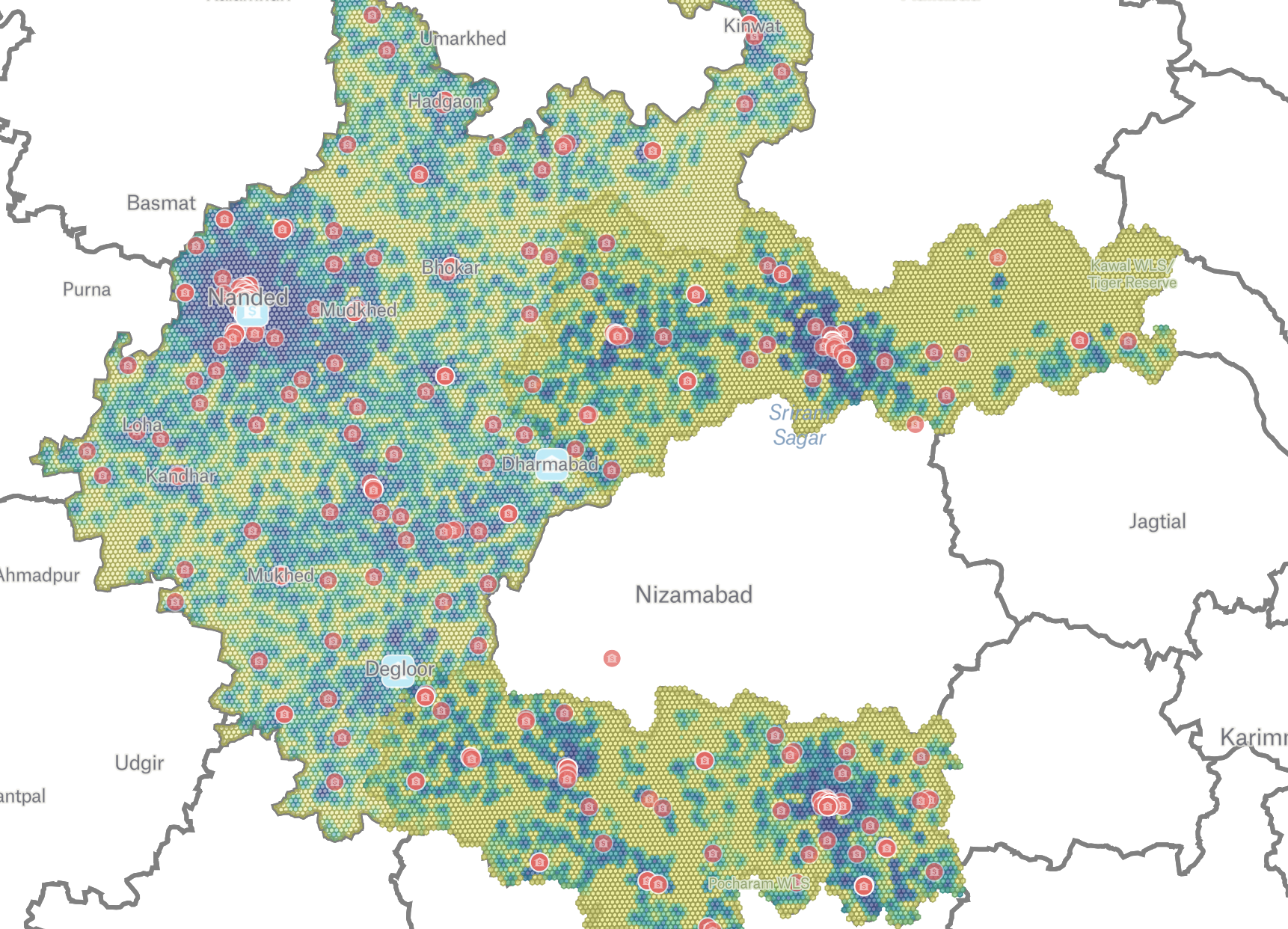
Rural deposit potential at hexagon resolution

What the model achieved

Back-tested against the bank's own deposit data in a single-district pilot before scale-up.

90%
Validated
Model accuracy against actual deposits for the top three deciles.
6
Scope
Micro-market classifications, one applied to every hexagon.
100+
Scope
Signals carried per 500m hexagon.
7k to 11k
Scope
Hexagons per district. One village is five to ten of them.

The case

01 · Two channels, one blind spot

Nobody could rank a micro-market

Internal officers and external banking correspondents both worked from branch-level targets with no view below the branch.

02 · District data is too coarse

Regulatory data stops at the district

Two branches in the same district look identical in the published deposit figures, whatever their actual share.

03 · The real question

Acquisition is a balance transfer game

Almost every household already holds an account. Finding the unbanked is the wrong question in these markets.

The question changed from who is unbanked to where the deposit sits

Rural deposit growth is won by moving balances that already exist. That reframing set the model: estimate the deposit pool inside every hexagon, then subtract what competitors already hold.
District
regulatory deposit total
Published savings, current and term deposit balances set the total addressable pool.
→
Hexagon
estimated potential
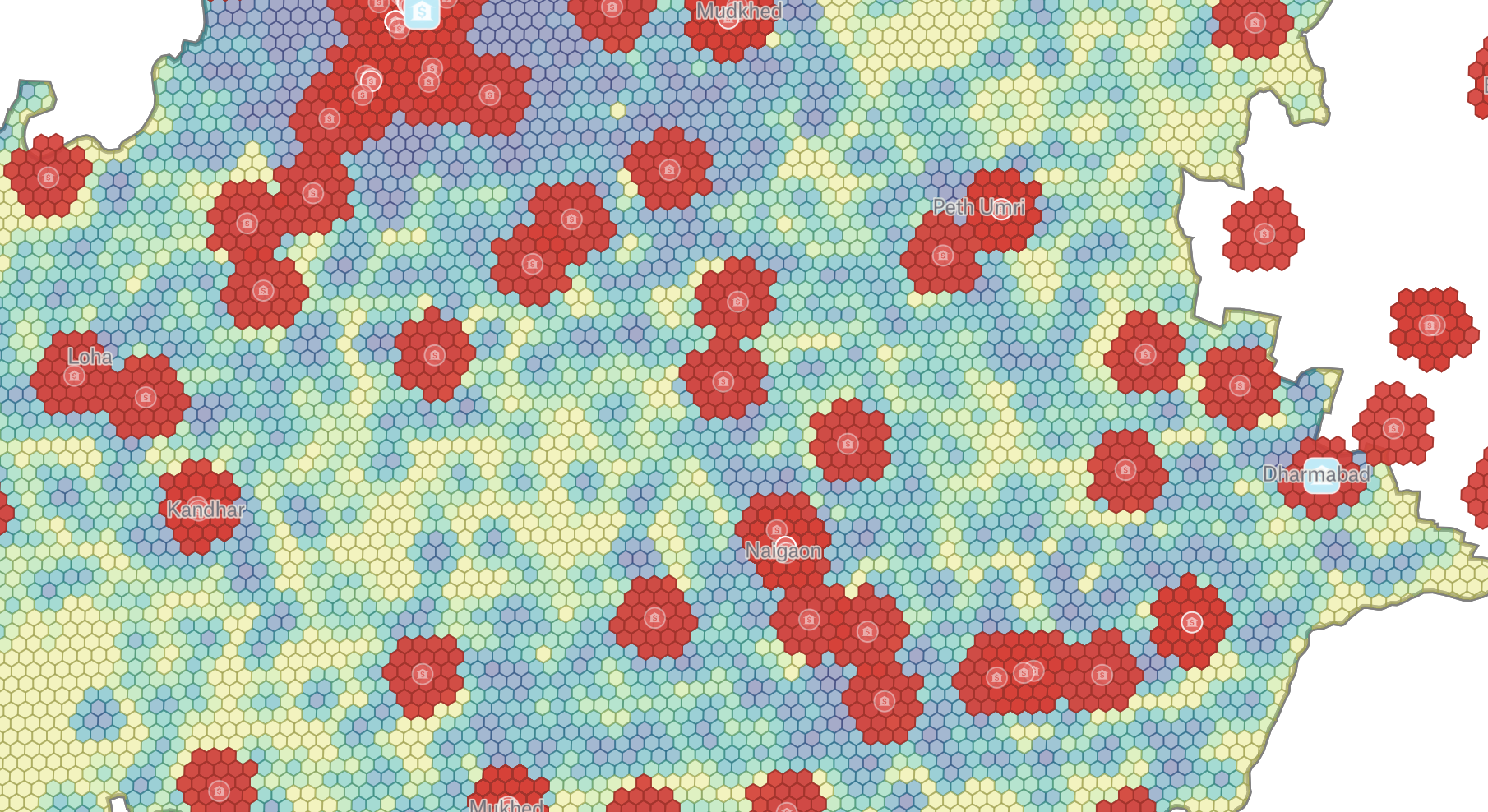
The district total is decomposed across every cell using population, vibrance and business signals.
→
Net of
competitor absorption
Rival branches are modelled as gravity wells, weighted by trust tier and branch age.
→
Ranked
shortlist per branch
What reaches a field officer is three to five hexagons for the week, with a segment target attached.
District total decomposed to hexagons

What was scored

Public and licensed signals, anchored to published district deposit totals.

Anchored deposit estimation

Regulatory district deposit balances split into savings, current and term components.

Keeps every hexagon estimate tied to a published total instead of a free-floating model.

Competitor trust tiers

Banks, cooperative banks, small finance banks, payments banks and post offices, each weighted by tier and branch age.

A large public sector branch absorbs far more local deposit than a payments bank outlet on the same street.

Business ecosystem

Business registry entries and 125 point-of-interest categories, weighted by local wealth.

Current account and term deposit potential tracks commercial density more closely than headcount.

Catchment geometry

Branch catchment overlap, leakage past a nearer competitor, and natural boundaries.
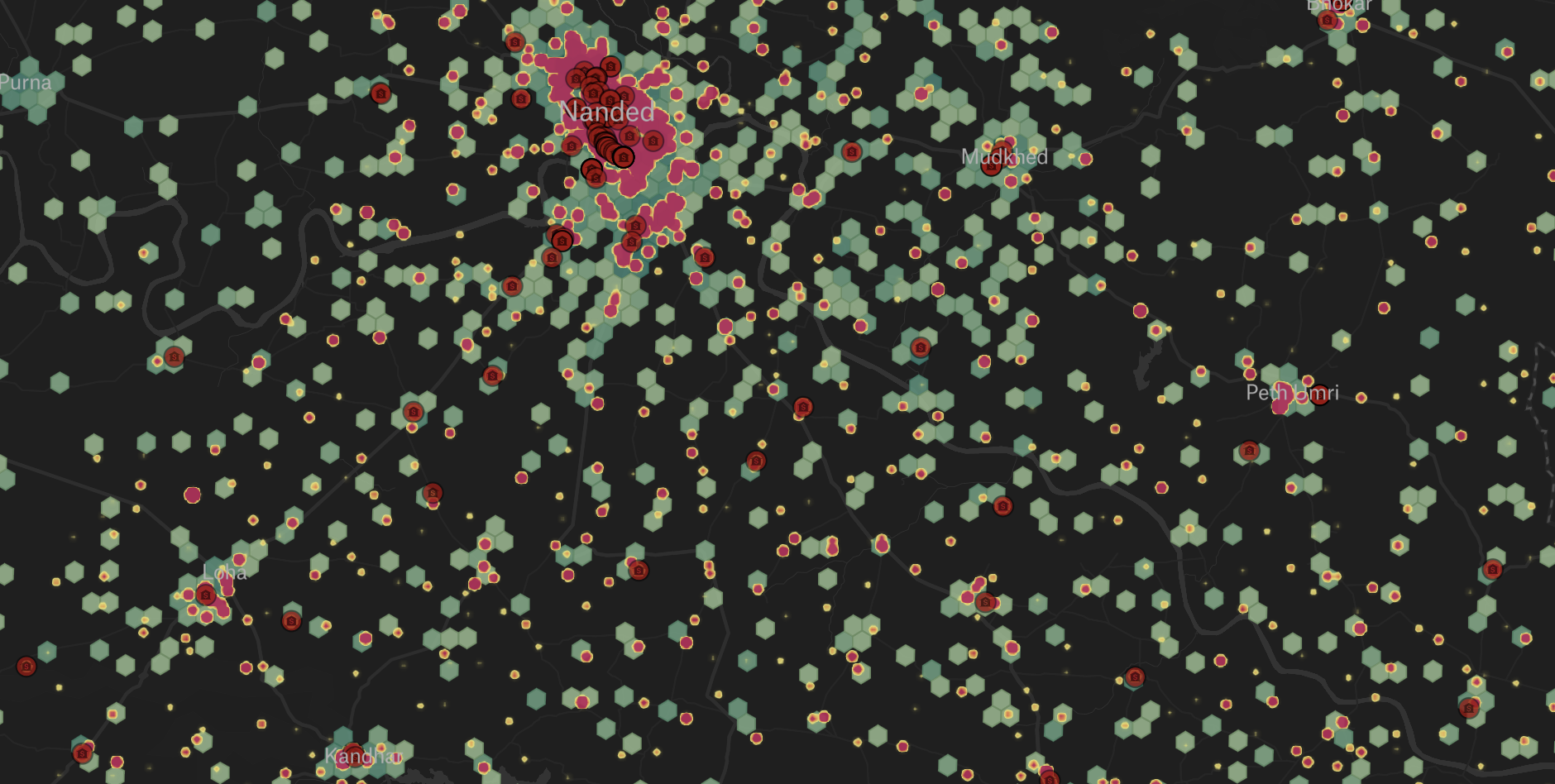
Separates genuine white space from deposit the branch is already losing to a closer rival.
Signal layers behind the estimate

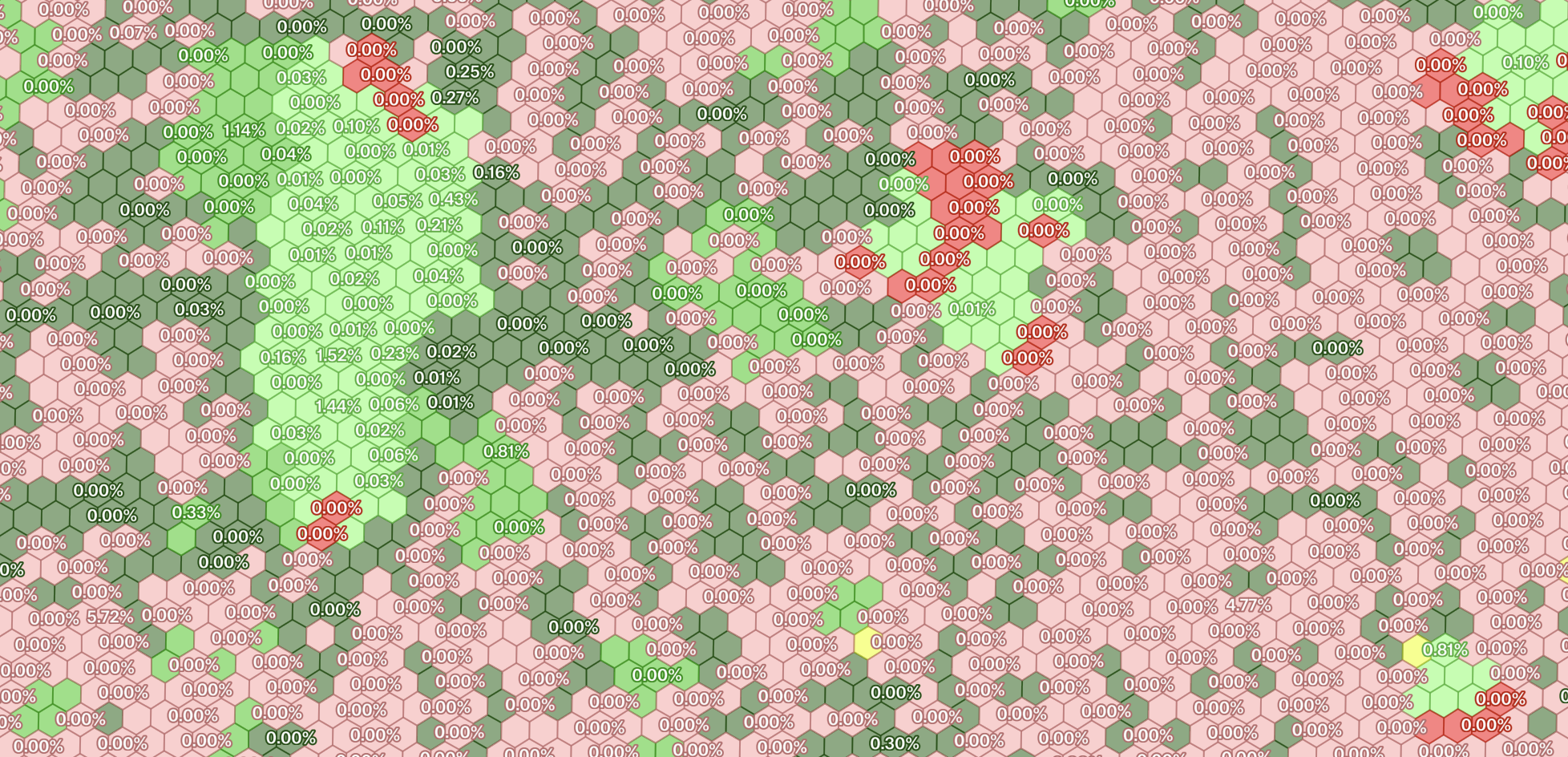
Every hexagon lands in one of six classes

The class sets the instruction. A branch team reads the colour and knows the play.
Classification
What it means
Action
Primary Expansion
High potential, low competitor absorption. Blue ocean.
Build presence first
Growth Market
Rising potential with room still open.
Increase field frequency
Competitive
Real potential, entrenched rivals.
Compete on balance transfer
Core Stronghold
Existing share concentrated here.
Defend and deepen
Digital Service Zone
Potential too thin to justify physical servicing.
Serve digitally, avoid field cost
Saturated Dead Zone
Absorbed by competitors, no realistic headroom.
Exclude from field plans
Six classes across a district

What each team received

One output per role. No new system, no mapping skills required.
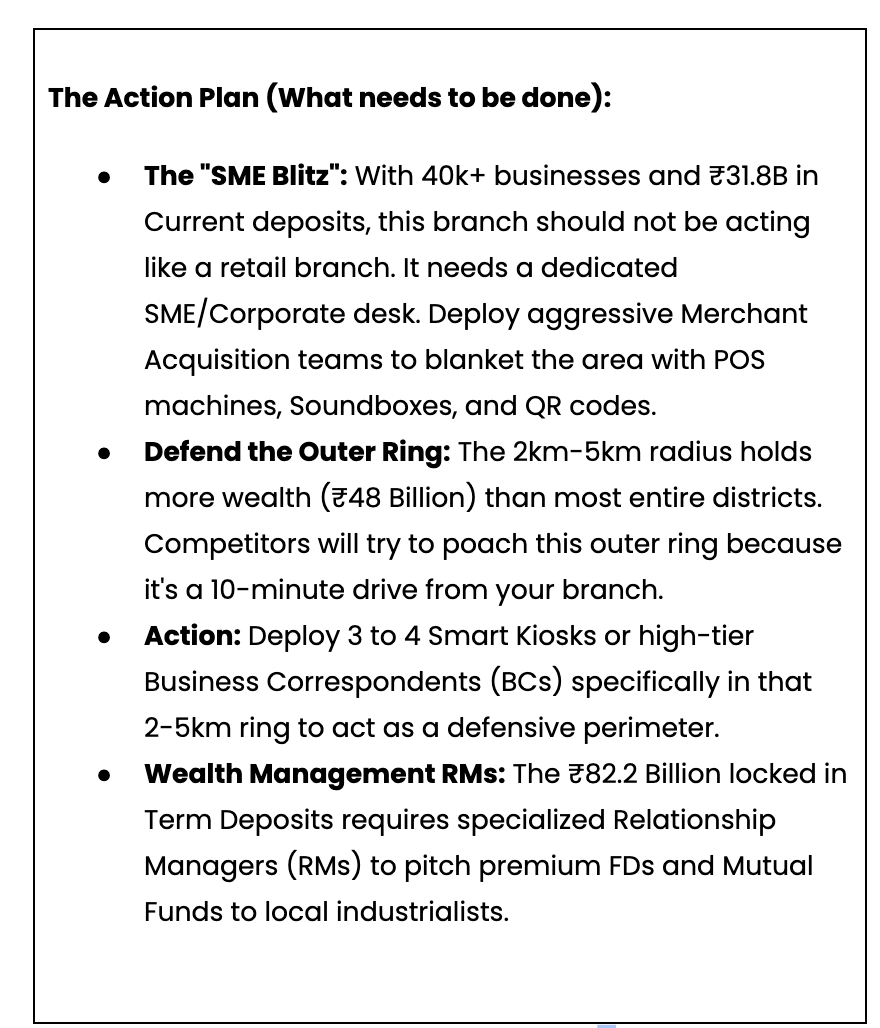
Leadership intelligence pack
Leadership

Review briefs by cluster

Pre-packaged branch, area and regional briefs surfacing neglected blue ocean zones and over-invested battlegrounds, so reviews start from the gap instead of the outcome.
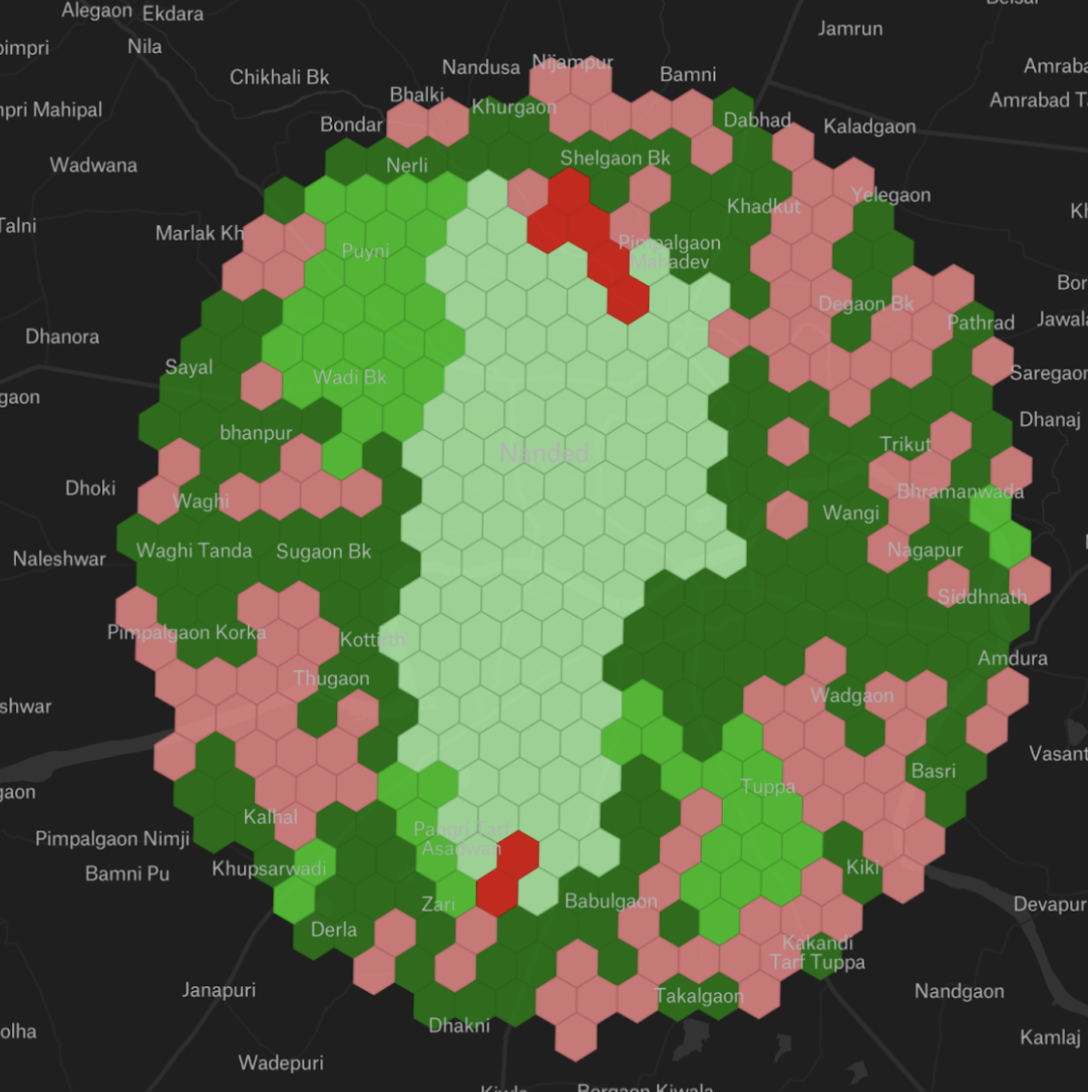
Branch catchment view
Branch and area

Catchment and leakage map

Where the branch is losing deposit to a nearer competitor, where its stronghold actually ends, and which adjacent pockets are unclaimed.
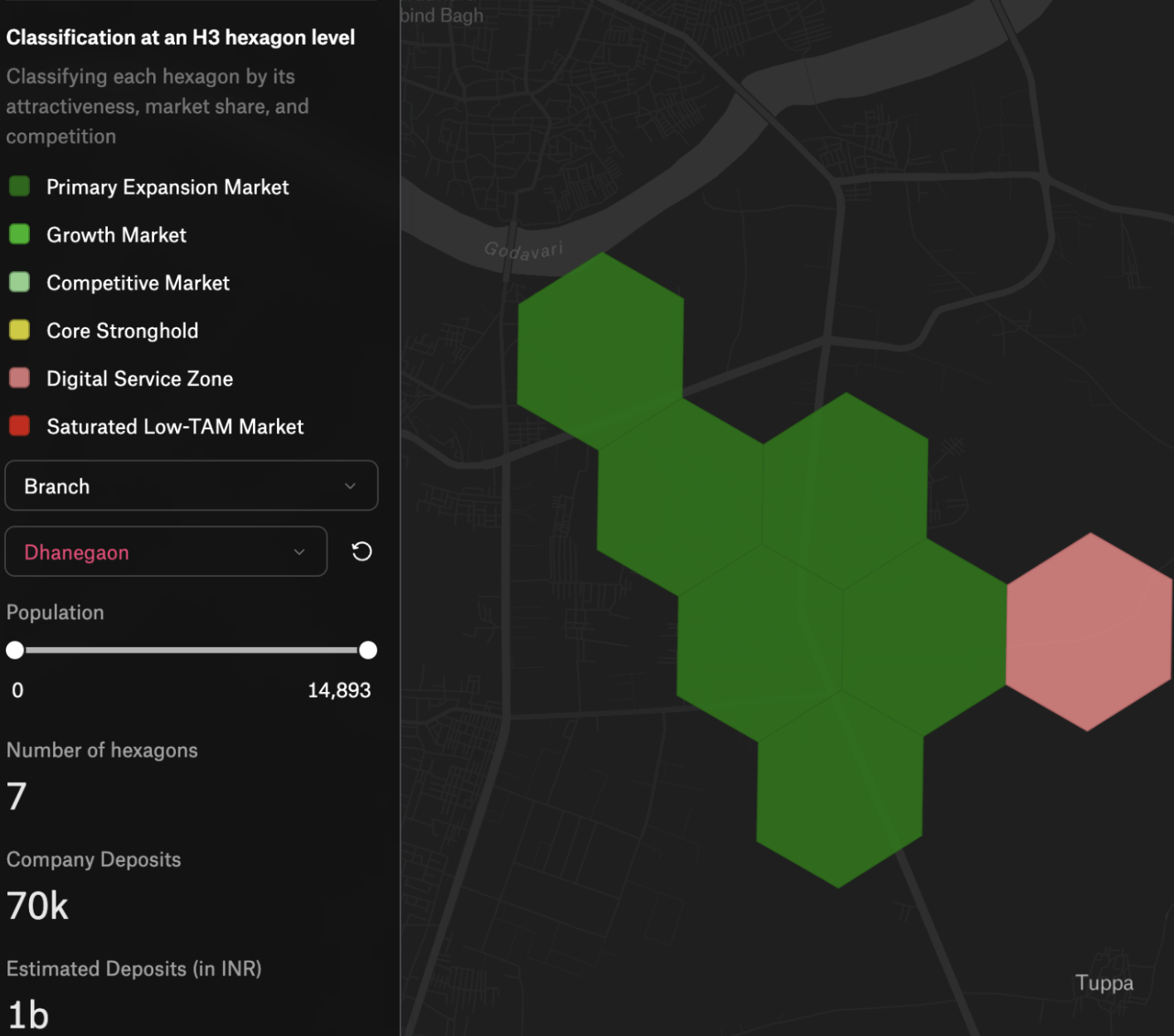
Field battle card
Field

Three to five hexagons a week

Action cards carrying coordinates, the segment to target and a visit priority, available in regional language and forwardable into the field app already in use.

How the workflow changed

Before
Targets set at branch level with no view below it
Field officers chose their own villages by familiarity
Competitor pressure understood anecdotally
Reviews tracked outcomes and debated the reasons
External partner channels worked without shared priorities
→
After
Every hexagon carries an estimated deposit pool and a class
Weekly hexagon assignments reach officers as action cards
Competitor absorption is modelled and netted off
Reviews open on the gap between coverage and potential
Internal and partner channels work the same ranked list

How the engagement is measured

Three gates, each agreed with the bank before modelling began.

Gate
Model accuracy against field ground truth.
60 to 70%
Checked by
Joint audits comparing high and low potential hexagons against what teams find on the ground.
Gate
Catchment utilisation against a captured baseline.
Improvement
Checked by
Branch-level utilisation measured before recommendations were issued, then re-measured.
Gate
Deposits per visit in recommended zones against organic zones.
Differential
Checked by
Visit compliance logged against the hexagons the model prioritised.
We get data at a district level, and no one knows how to deeply look inside it. Branches have been made historically and leadership needs an objective view to make sure the goals and staffing are done correctly.
Bank Leadership
During scoping

Start with one district.

Share branch locations and three months of deposit performance. We will estimate the pool hexagon by hexagon and you can check the top decile against what your teams already know.

Set up a workshopMore Transformation Examples