A small finance bank assessed secured lending demand by pin code, which is too broad to choose a camp site. Demand was mapped at micro-market level, and camps were planned around the strongest ones.
Now it scales to hundreds of branches and thousands of locations. Measured from the sourcing camps the model recommended.
Assessing viability across a whole PIN code excludes sound borrowers who happen to sit inside a historically weak one.
Default behaviour differs sharply between neighbouring pockets, and a district-level view averages that away.
When a team declined a recommended market, leadership could not tell a genuine constraint from a convenient one.
A score from zero to one hundred is built for each pocket, indexing commercial capacity rather than credit quality. Dense, active neighbourhood economies show up as standalone units even when the postcode around them looks weak.
Satellite-derived concrete building counts and total built-up area.
Verified points of interest and registry entries, separating genuine commerce from residential frontage.
Quality multipliers covering pharmacies, grocers, schools and institutional presence.
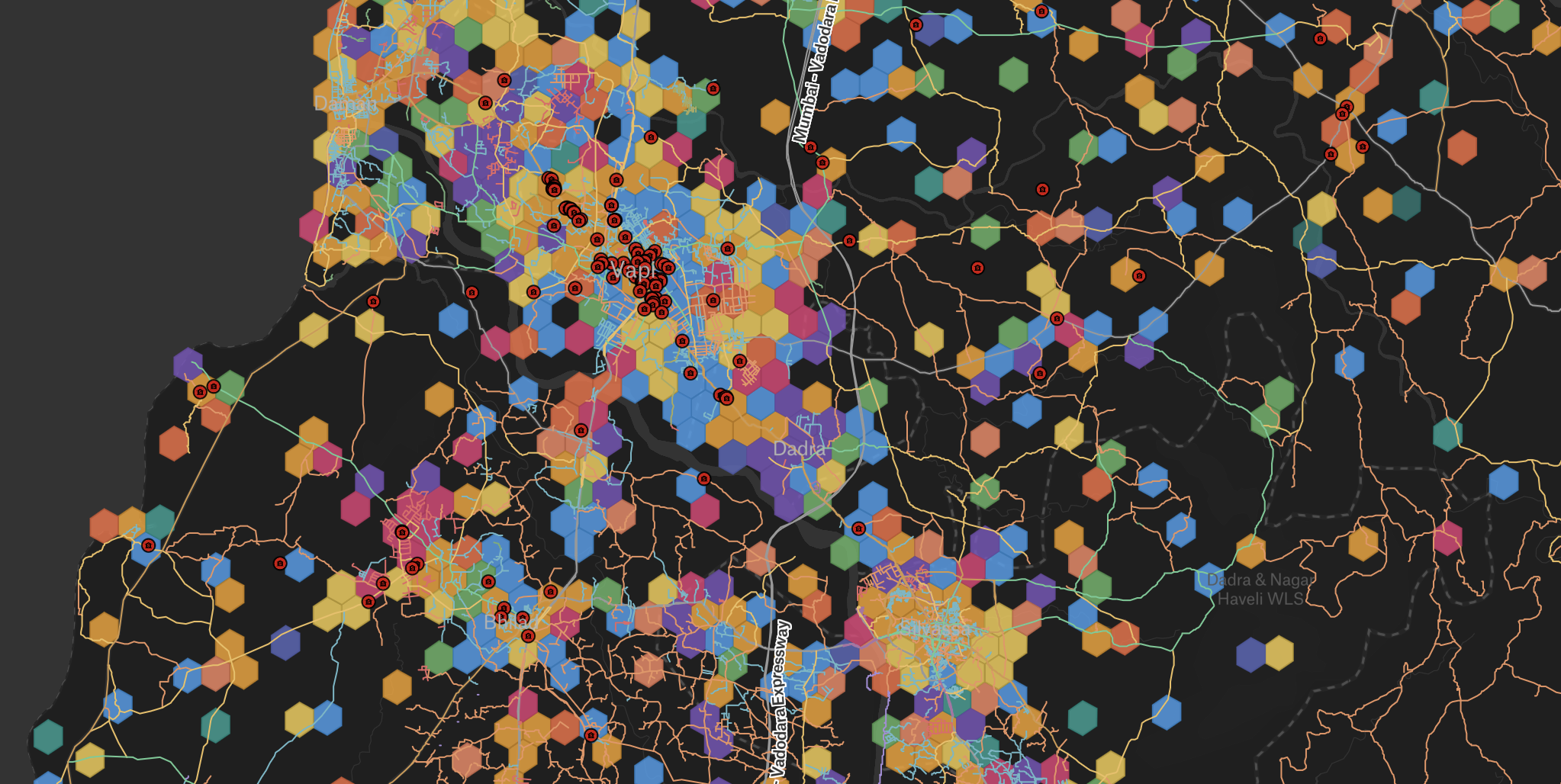
Eight composite scores per hexagon, each assembled from its own attribute set, plus a client-provided risk overlay.
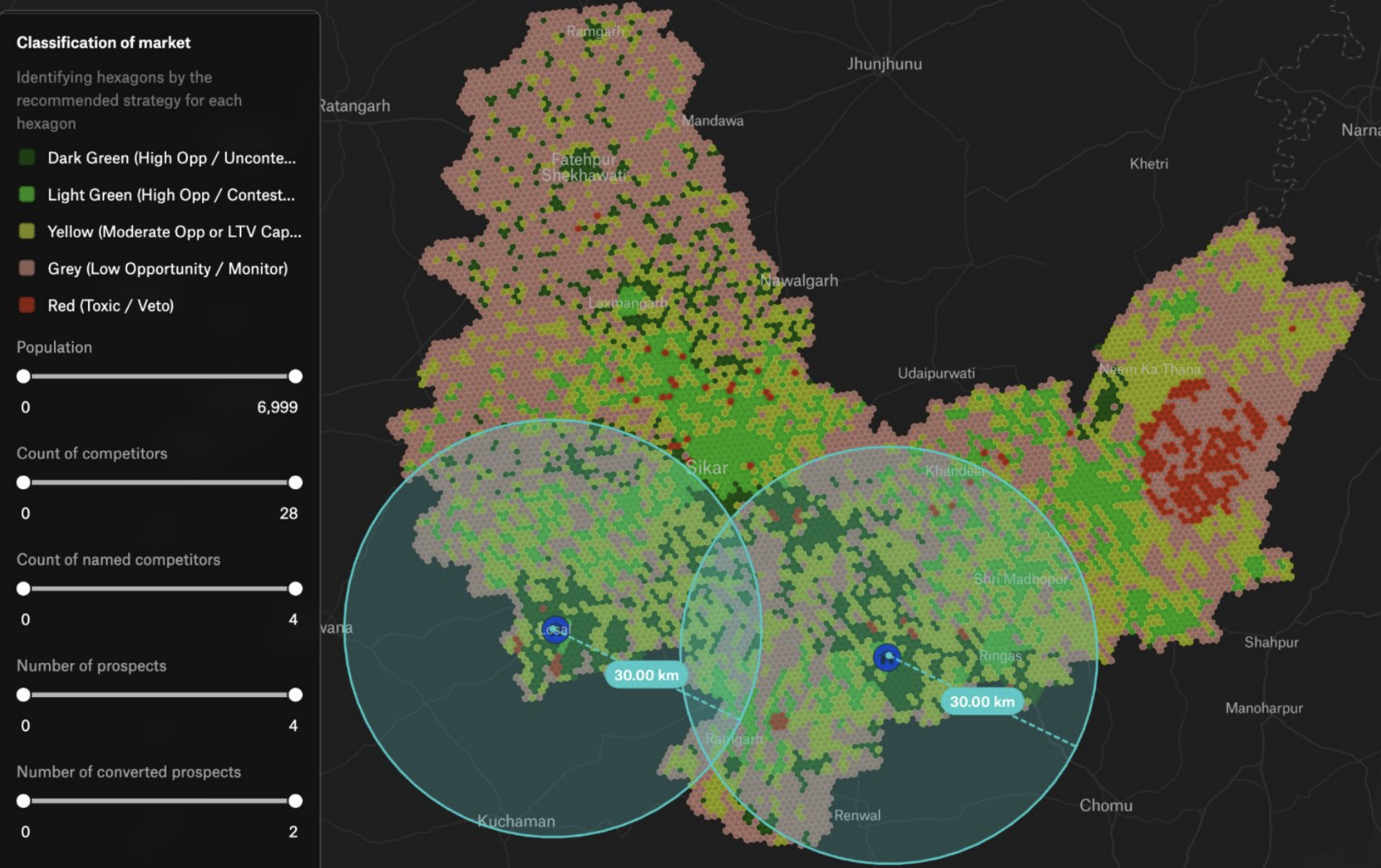
Every score is attributable. A regional head can ask why a hexagon was classified as blue ocean and see the signals behind it.
A market can be commercially strong and still fail the risk gate. Toxicity vetoes the classification outright.
One output per role, ending in a document a branch could run a camp from.
District-wide classification with the signals behind every hexagon visible, so a challenge can be answered with evidence instead of assertion.
Opportunity ranked after the risk overlay, so a market that looks strong commercially and carries toxic peer behaviour never reaches the field plan.
Location strategy documents naming the hub, the commercial strip to work, the ticket size the market supports and which branch should lead the camp.
The classification decided the strategy before the camp was scheduled.
This is why every classification carries its inputs. When a team declines a market, the conversation moves to the specific signal they disagree with, which is a question that can be settled by going there.
We will model the district, hand you the camp dossier, and you can judge it against the market your team already knows best.
Set up a workshopMore Transformation Examples