Transformation · Automotive

Finding the markets where used farm equipment sales will hold up.

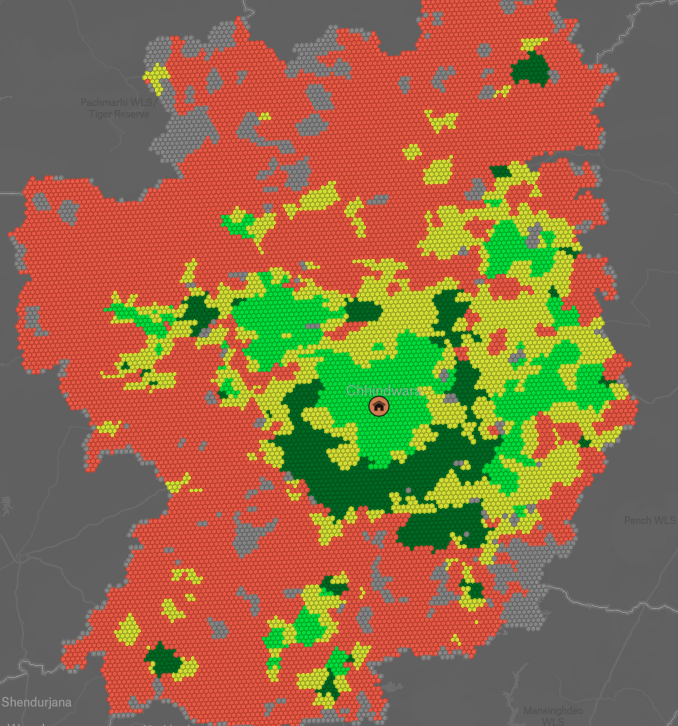
A used farm equipment business needed to know where demand would last. Markets were assessed on farm income, road access and climate risk, so the network could follow demand beyond where dealers already sit.
Used equipment marketplace
Agricultural machinery
Rural micro-markets
Agricultural productivity surface

What was designed

A working signal set across five categories. This is a designed model rather than a completed deployment, and the figures below describe its shape.

50
Scope
Signal categories, from demand through to climate risk.
500m
Scope
Hexagon resolution at which every signal resolves.
5+ years
Scope
Cropland change window used to separate growing markets from shrinking ones.
40+ years
Scope
Drought frequency history behind the volatility flag.

The case

01 · Buyers are concentrated

Demand sits in specific pockets

Used equipment buyers cluster in agriculturally productive micro-markets, and those pockets are much smaller than a district.

02 · Demand alone is misleading

A sale still has to be serviced

Delivery, inspection and repossession all depend on physical access, which is invisible in any demand measure.

03 · Farm income is volatile

Good years and bad years lend differently

A market with strong output and a history of drought carries repayment risk that a snapshot of productivity will not show.

Demand, access and volatility, in that order

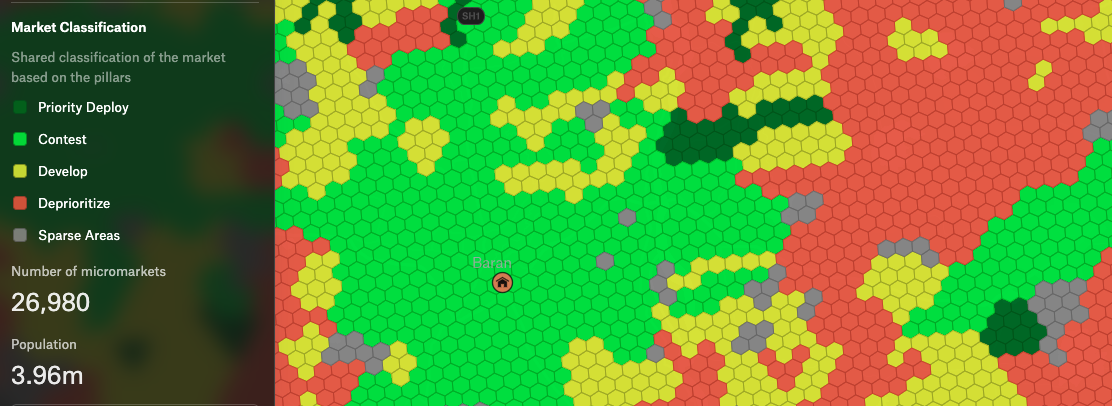
A micro-market has to clear three separate tests. Strong agricultural output makes it a candidate. Road and warehouse access makes it operable. Climate history decides the terms on which a sale should be financed.

01
Demand
Cropland cover, output and the five-year direction of travel. Expanding cropland signals latent mechanisation demand.
→
02
Intent
Farmer producer organisation density and equipment dealer presence, which indicate organised, credit-linked farming.
→
03
Access
Highway distance, road width and warehouse proximity. A tractor has to be delivered, inspected and if necessary recovered.
→
04
Terms
Drought and flood history sets loan tenor and deposit requirement rather than excluding the market outright.

What gets scored

Each signal answers a specific question about whether a sale can happen and can be serviced.

Agricultural output and land change

Cultivated area, crop type and seasonal productivity, with cropland expansion or contraction over five years.

High output means farmers with both the income and the reason to replace equipment. Shrinking cropland signals a declining resale market.

Producer organisation density

Registered farmer collectives within a short radius.

Organised, credit-linked farming communities buy collectively and qualify for finance, which makes them the highest-intent buyers.

Road type and width

Road classification and physical width per hexagon.

Tractor delivery and resale logistics need a minimum road width. A narrow rural track blocks operations regardless of demand.

Drought and flood history

Hazard propensity per hexagon and long-run drought frequency.

Volatile farm income produces defaults in stress years, which is a pricing input rather than a reason to exit.

How a micro-market gets treated

The combination of demand, access and volatility sets both the effort and the finance terms.
Market type
What it means
Action
Productive and accessible
Strong output, expanding cropland, good road access, stable climate history.
Concentrate listings and field effort
Productive and volatile
Strong output with a persistent drought record.
Serve on shorter tenor or higher deposit
Productive and unreachable
Real demand behind roads that cannot carry delivery.
Serve from an adjacent hub, or not at all
Contracting
Cropland shrinking over the measured window.
Reduce exposure ahead of the decline
Demand and access, side by side

What each team would receive

The same hexagon layer, resolved differently by function.

Leadership

Market prioritisation

Which regions carry both mechanisation demand and the infrastructure to serve it, which decides where the marketplace invests in supply.

Finance and risk

Terms by micro-market

Climate volatility per hexagon, so tenor and deposit requirements can vary with the market rather than sitting at a single national default.

Field and supply

Dealer and repair coverage

Equipment dealer and repair centre density mapped against demand, which surfaces the areas holding buyers and no service infrastructure.

What would change

Today
Market priority set by state and district volume
Access assumed rather than measured
Finance terms applied uniformly across geographies
Climate risk considered only after defaults appear
Service coverage gaps discovered on the ground
→
With the signal set
Priority set at micro-market resolution
Road width and warehouse proximity scored per hexagon
Terms varied by measured climate volatility
Drought history carried as a standing market attribute
Service gaps identified before supply is committed

Where this work stands

A designed signal set, published so it can be argued with before anything is built on it.

Completed
Signal design across five categories, with sources and granularity named for each.
Done
Next
Selection of a pilot geography and calibration of weights against the marketplace's own transaction history.
Not yet done
Back-testing against completed sales.
Open
Next
The model earns its weights by explaining sales that already happened before it recommends new markets.
Not yet done
Field validation of the access thresholds.
Open
Next
Minimum road width for delivery is an operational fact the client can confirm faster than any dataset.
We want to double down on where we spend time and marketing efforts so our dealerships get profitable faster.
Rural Lender
On assessing farm-dependent markets

The question applies directly to used equipment. Farm income decides whether a machine gets bought and whether the finance behind it performs, so cropland change and drought history belong in the market model rather than in a post-mortem.

Calibrate it against sales you have already made.

Send anonymised transaction locations. We will score those markets and show you whether the signal set explains where your business already comes from.

Set up a workshopMore Transformation Examples