Transformation · NBFCs

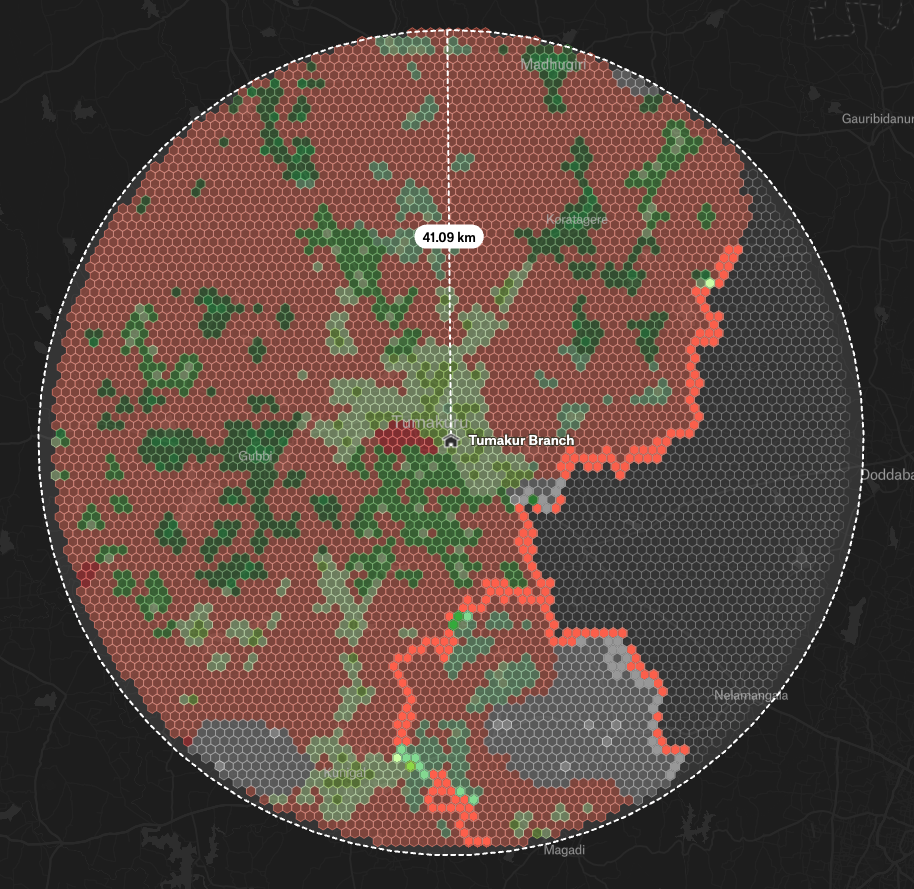
Sourcing hotspots found inside a single 40 km branch catchment.

An NBFC lending against property was working its catchments evenly. Scoring showed the sourcing opportunity sat in a handful of pockets inside a 40 kilometre radius, not spread across it.
NBFC
Loan against property
Self-employed and MSME
Branch catchment scored by hexagon

One catchment, in four numbers

The input scale behind a single branch analysis.

2.4M
Scope
Building footprints assessed for collateral availability.
71,000
Scope
Registered MSMEs inside the catchment.
31,000
Scope
Road segments scored for collections and valuation access.
40 km
Scope
Catchment radius from a single branch.

The case

01 · Expansion at pace

Fifty branches to open

A branch programme of that size cannot run on local judgement without producing inconsistent results across regions.

02 · Visits without direction

Tracking existed, targeting did not

The business could already see whether officers had made their visits. It could not say whether the visits were in the right places.

03 · A HARD TO FIND BORROWER

Self-employed, with pledgeable property

The target borrower is defined by two things at once, and neither shows up in population data.

Three weighted pillars, then a smoothing pass

Each micro-market is scored on demand, on whether the business can actually be executed there, and on who already lends in it. The result is then blended with neighbouring hexagons, because a lending corridor that sustains a branch is wider than a single cell.

Vibrance
50% weight
Infrastructure suitability
30% weight
Competitive intensity
20% weight

Competition is treated in two directions rather than one. Co-operative lenders in a market are an opportunity to win business from. Direct competitors at the same ticket size are a penalty, because they have already taken the demand.
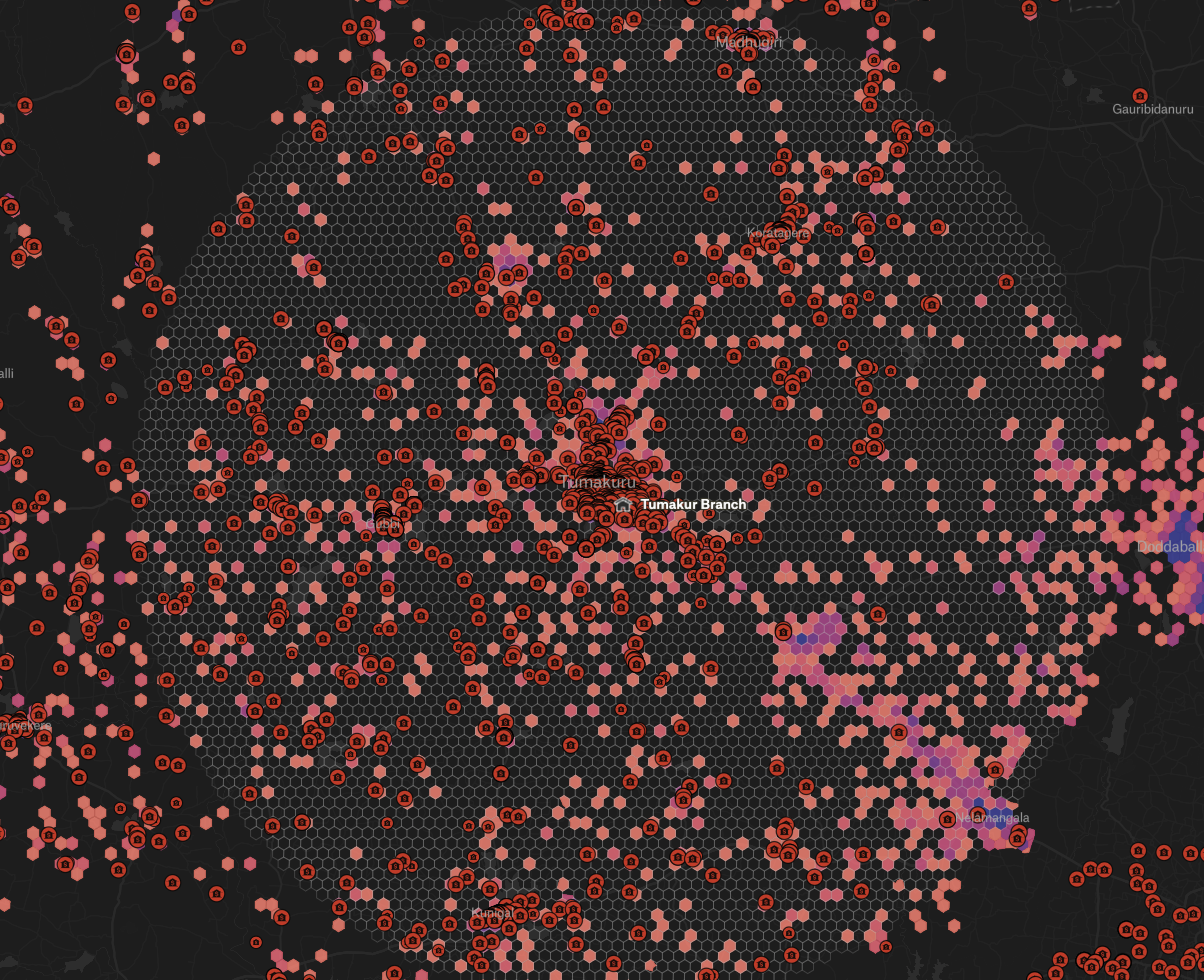
Weighted pillar scoring across the catchment

What was scored

The signals that separate a borrower who can pledge property from one who cannot.

Business type and working capital need

Points of interest and registry entries, weighted by sector.

A rice mill or a food processing unit needs working capital and holds pledgeable property. A service business often has neither.

Building density

Building footprints across the catchment.

Collateral availability is a physical fact before it is a credit assessment.

Road network quality

Road classification and connectivity per hexagon.

Determines whether valuation and collections can be run at acceptable cost.

Lender presence by type

Bank and non-bank branch locations, separated by lender category.

Distinguishes a market to win business from and one already worked at the same ticket size.

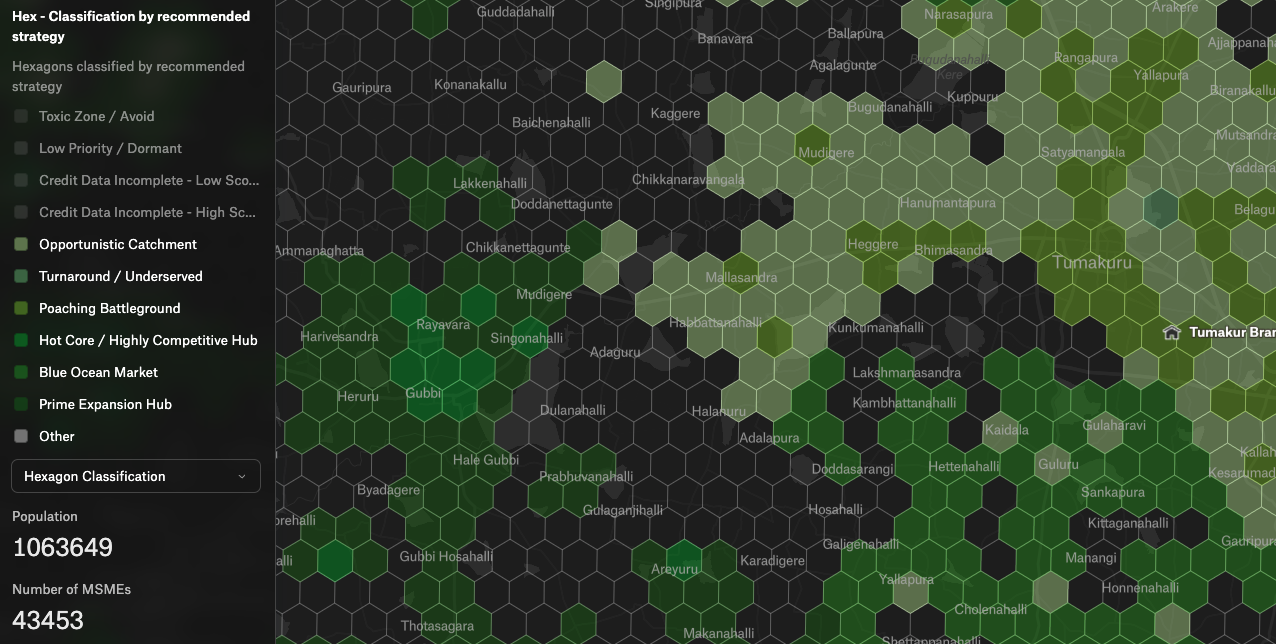
Ten classes, in descending priority

The classification names the strategy, and it also names the cases where the model is working with gaps.
Class
What it means
Action
Prime Expansion Hub
Large market, strong growth, low competition.
Anchor a physical branch
Blue Ocean Market
Fast growth from a small base, minimal competition.
Deploy agents for first-mover position
Hot Core
Booming and already saturated.
Move fast or stay out
Poaching Battleground
Mature market with cooling growth and high competition.
Target frustrated customers of incumbents
Opportunistic Catchment
Mixed signals supporting secondary expansion.
Cover by roaming agent, not a branch
Credit data incomplete
Commercial activity is clear, bureau coverage is missing.
Proceed on alternative signals, with caution
Micro-markets by classification

What each team received

The output had to reach a field officer without a new interface.

Leadership

The shape of the catchment

How the micro-markets in a branch radius distribute across classifications, which sets how much of the catchment is worth staffing at all.

Branch

A stack-ranked roadmap

Micro-markets ordered by opportunity score, each carrying the classification and the summary of the raw signals that produced it.

Field

A landmark to visit

Each priority hexagon is mapped to a recognisable landmark inside it. The officer visits the landmark, which is how canvassing gets concentrated and how the visit gets confirmed without a new app.

How the workflow changed

Before
Location strategy set by local teams, branch by branch
Field visits tracked for completion, not for placement
Target borrowers identified case by case
Competitor presence understood anecdotally
No way to compare one catchment against another
→
After
Catchments scored centrally on a single method
Visits directed to ranked micro-markets
Borrower-rich pockets identified before canvassing
Competition scored by lender type and netted off
Catchments comparable on the same opportunity score

How success gets attributed

The measurement design was settled before the pilot started, including the part where a rise does not count.

Signal
Logins and disbursements rising inside a recommended hexagon.
Measured
Basis
Compared at hexagon level rather than at branch level, so the effect is traceable to the recommendation.
Duration
A single month can move on noise.
3 months
Basis
The pilot runs long enough that an outlier spike or dip does not decide the result.
Attribution bar
Any increase is not automatically EPIC's.
Threshold
Basis
Only movement above a jointly agreed expected disbursal threshold is attributed to the recommendation.
When we open a new location, it typically takes 18 months to ramp it up. In the process, we have to deeply rely on local talent, which brings its own biases.
Client Leadership
During scoping

Start with one branch catchment.

Give us a branch and the radius it serves. We will rank every micro-market inside it and show you where your officers are not going.

Set up a workshopMore Transformation Examples