A housing finance company reviewed branch performance quarterly, by which point a weak quarter was already spent. Each catchment now carries weekly signals on utilisation, competitor movement and officer coverage, with alerts that fire early.

Agreed with the client before deployment. Each one fires an alert to a named owner.
After funding cost, credit cost and operating expense, net contribution at a typical branch is slim enough that small movements matter.
Concentration, neglect and funnel leakage all appeared in reporting only after a quarter had already been lost.
Officer territories were set once and then drifted, with nobody measuring how far actual coverage had moved.
Weekly hexagon-level counts from the client join to EPIC market signals. Classifications update, and three conditions fire automatically to a named owner rather than waiting for a review.
A single hexagon passes the share threshold while arrears rise. New sourcing from that hexagon halts and collections are alerted.
A top-quintile hexagon records no officer visits inside the window. The branch manager assigns it in the next weekly plan.
Lead to login conversion drops inside a hexagon that was performing. The branch investigates a local cause rather than a general one.
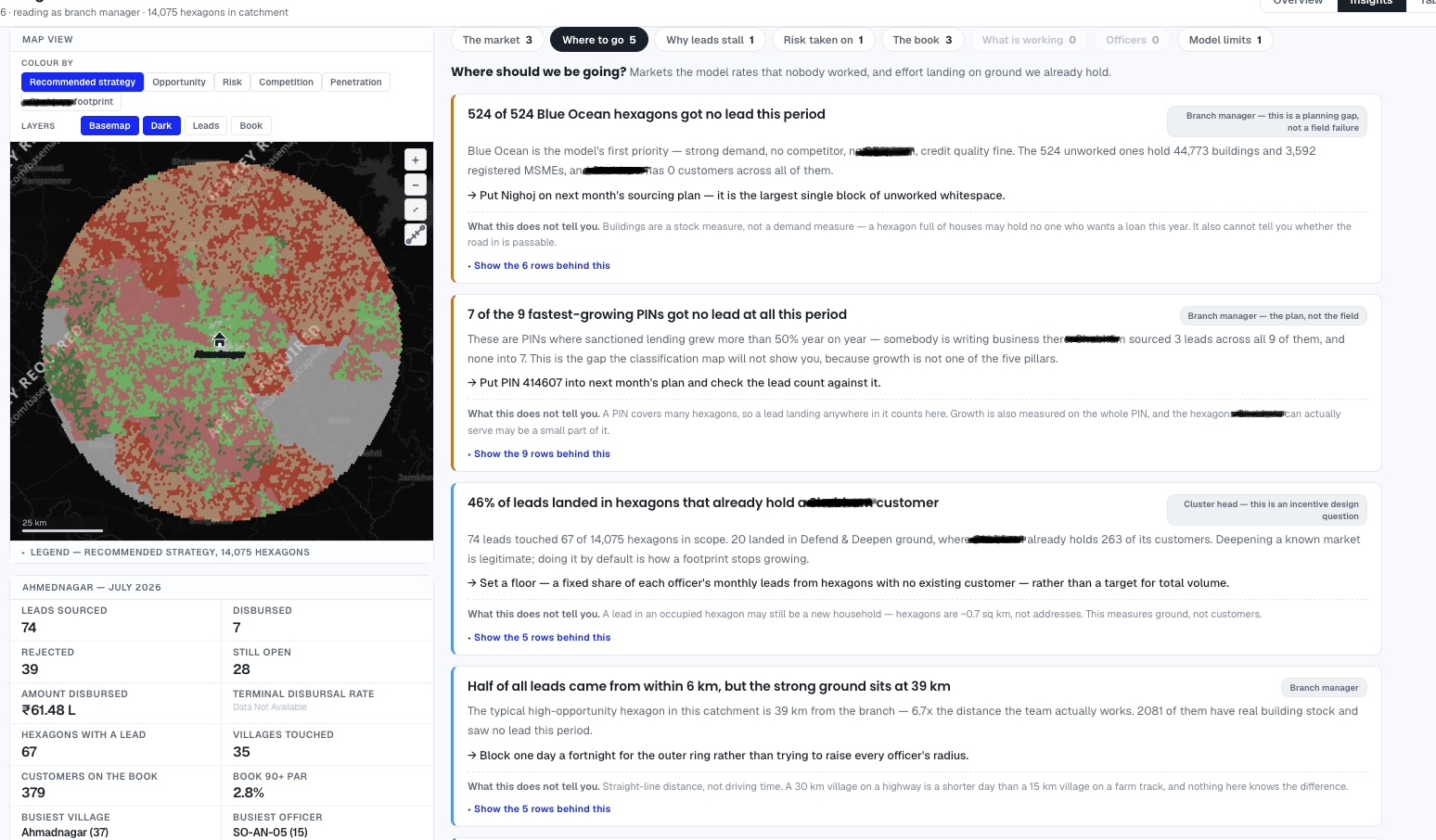
Market signals from EPIC, operational counts from the client, combined at hexagon level.
Built-up area, building counts and construction propensity.
Business density, registry presence and sector mix.
Weekly aggregated leads, logins, disbursals and visits per hexagon.
Arrears and concentration summarised to hexagon, never to a customer.
The exchange is a weekly file of counts per hexagon. No customer names, no addresses, no individual loan amounts, no identifiers of any kind. Every output is aggregated at 0.7 km² and the arrangement is compliant with the Digital Personal Data Protection Act 2023.
A market that recovers has to be able to earn its way back, otherwise the model quietly blacklists places forever.
Weekly for the field, monthly for the network.
Branches ranked by the gap between sourcing and opportunity, with concentration alerts where an officer has over-indexed on one zone and operating cost flags where travel has spiked.
Officer coverage against the priority map, naming the specific hexagons that carry opportunity and have gone unvisited.
Full re-run against the last month of operational data, with hexagons moving between classifications and territory rebalances recommended where coverage has drifted.
Three levers against branch profit and loss, modelled on the client's own branch economics and stated conservatively. These are projections.
Net contribution at a branch of this size is thin, so each lever is material rather than marginal. The improvement opportunity here is structural.
Opportunity is defined against the branch itself. A hexagon in the top quintile of its own catchment on construction and commercial signals, carrying clean portfolio behaviour, and receiving no officer visits. That combination is specific enough to assign to somebody on a Monday.
Send a week of aggregated hexagon counts. We will classify the catchment and show you which high-opportunity pockets your team has not visited.
Set up a workshopMore Transformation Examples