Transformation · Micro Finance

Matching each branch to the lending model its market can sustain.

A rural lender ran one lending model across every branch. Each branch was matched to the model its surrounding market can actually sustain, and the results were checked against field data before any rollout.
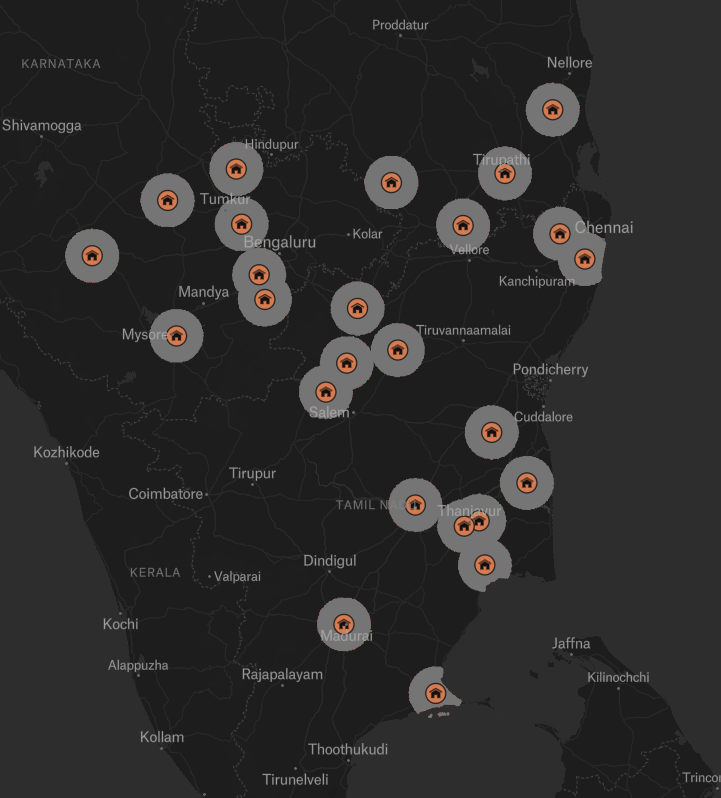
Rural financial services
Group and enterprise lending
Multi-state branch network
Branch service area as a digital twin

The rollout, in four numbers

Phased deliberately so that technical validation happens before large capital commitment.

50
Scope
Branches reclassified in the pilot phase.
400+
Scope
Branches across the full network once all phases complete.
70%
Gate
Ground-truth correlation required before the pilot can progress.
25 km
Scope
Service area modelled per branch at hexagon resolution.

The case

01 · Two products, one plan

Branches sold both the same way

Group lending and enterprise lending were pushed through the same branches without distinguishing which markets suited which.

02 · Affluence read as opportunity

The strongest markets were the wrong ones

A prosperous commercial cluster looks like a prime target on any demand measure, and it is often unsuitable for group lending precisely because it is prosperous.

03 · Scale before proof

A network-wide rollout is a large commitment

Deploying across several hundred branches without a validation stage puts capital behind a model nobody has checked on the ground.

A branch is not one market, and the product should follow the archetype

The same signals that make a micro-cluster attractive for enterprise lending can rule it out for group lending. High affluence proxies, dense registered businesses and strong road connectivity point one way. Group lending needs the opposite profile.

Archetype 01

Group-first

Residential density sufficient to form groups, low affluence proxies, thin formal competition. The branch leads with group lending.

Archetype 02

Enterprise-first

High-street ecosystem, dense registered businesses, strong connectivity. Group lending is unsuitable here and enterprise lending is the play.

Archetype 03

Hybrid

Both profiles present in different parts of the same service area, which is a territory design question rather than a product choice.
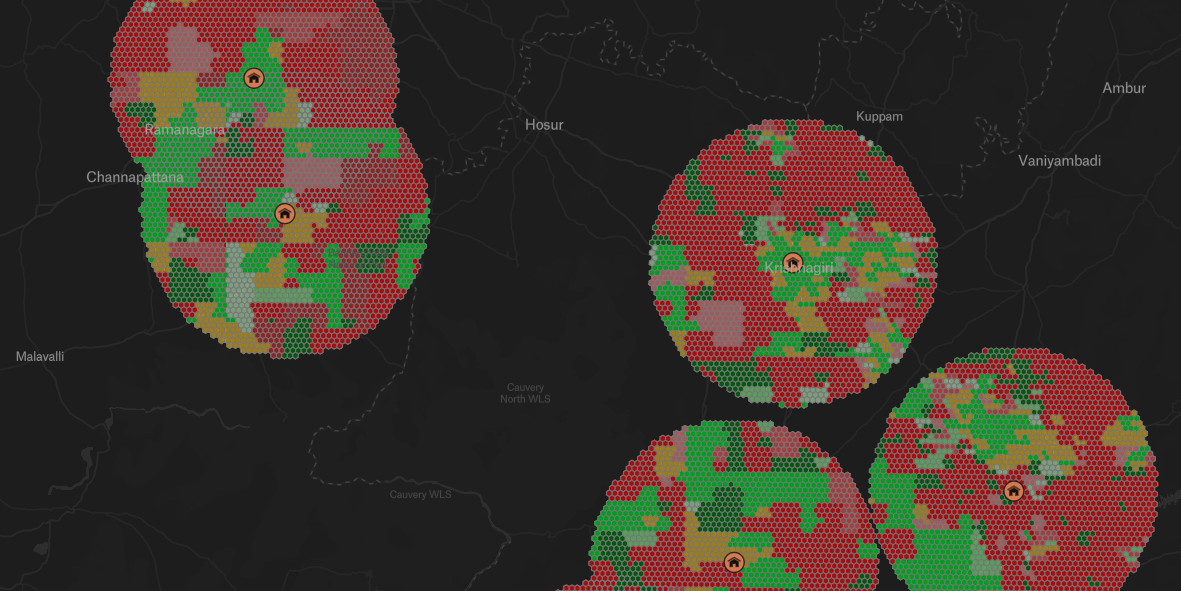
One service area, two product surfaces

What was scored

A worked example makes the method concrete. One micro-cluster in the pilot carried the following profile.

Digitally visible businesses

Over 70 registered entities, weighted toward apparel manufacturing, pharmacy and vehicle showrooms.

Business mix separates an enterprise lending market from a group lending one more reliably than headcount.

Local economy score

Rated 4.8 out of 5, driven by concentrated apparel manufacturing.

A single dominant trade signals an established value chain with working capital needs.

Building signatures

Over 450 structures carrying commercial height profiles.

Commercial building height distinguishes a high street from a dense residential block.

Competitor and infrastructure presence

Three non-bank lenders and two cash points within one kilometre.

Close-range competition and banking access both suppress the case for group formation.

This cluster scored as a primary enterprise lending target and was ruled out for group lending, on the same evidence.

Three outputs per branch

Each answers a different question, and each names the action.

Output
What it contains
Action
Market archetype report
Final classification of the branch as group-first, enterprise-first or hybrid.
Set the product the branch leads with
Digital twin map
Hexagon rendering of the service area with presence, risk concentration and opportunity as layers.
Redesign territory inside the radius
Prioritised hotspots
Villages and micro-clusters ranked by sourcing vibrance, each with a stated rationale.
Direct field effort to named places

The rationale matters as much as the rank. A hotspot listed as a dense textile cluster and one listed as an under-banked agricultural hub call for different conversations when the officer arrives.

What each team received

Deliverables arrive in sequence, matched to what each phase is trying to establish.

Zonal heads

Automated alerting

In the final phase, network-wide performance tracking with alerts raised to zonal level rather than waiting for a review cycle.

Branch leadership

An archetype and a hotspot list

The classification that sets which product to lead with, and the ranked micro-clusters inside the service area to work first.

Field teams

Movement tracked against recommendations

The second phase measures adoption speed directly, meaning how quickly teams pivot to the identified hotspots.

How the workflow changed

Before
Branches ran both products on the same territory plan
Affluent commercial clusters read as prime group lending targets
Service areas understood as a radius, not a surface
Adoption of any recommendation went unmeasured
Network changes committed without a validation stage
→
After
Each branch classified by archetype before the product plan
Affluence proxies used to rule markets out of group lending
Service areas rendered as hexagon-level digital twins
Adoption speed tracked as an explicit phase-two metric
A ground-truth gate stands between the pilot and the rollout

How the model gets audited

A joint field audit designed to test the contrast, rather than to confirm the winners.

Sampling
Eight to ten branches drawn from the hundred-branch pilot.
Joint audit
Method
A combined client and EPIC team visits micro-clusters using the maps, checking whether high-potential signatures match commercial reality on the ground.
Design
Confirming only the top-ranked markets proves very little.
Both ends
Method
The audit visits high and low potential villages, for both products, so the model is tested on its rejections as well as its recommendations.
Gate
Progression is conditional, not assumed.
60 to 70%
Method
Ground-truth correlation below the agreed band stops the rollout. The client is free to continue validating across the remaining branches independently.
Validating this with our field team was the most important step. So we did a field visit with EPIC to select branches and walked these markets. That validation gave us a lot of confidence.
Microfinance Lender
On external market data

That objection is the reason the audit is joint and the gate is explicit. Validation is not left to the client to fund and run alone, and the rollout does not proceed on assertion. If the maps do not match the ground at the agreed rate, the engagement stops there.

Start by classifying one region.

Give us the branches in one region. We will return an archetype for each and you can audit the ones you disagree with first.

Set up a workshopMore Transformation Examples