



For years, the dominant narrative about rural India has been one of distance - distance from markets, from institutions, from opportunity. We often assume villages are “behind the curve” on technology and innovation. But the past decade has made that story more complex. Digital infrastructure is now reaching India’s smallest towns faster than traditional services ever could, and the irony is that the very absence of legacy systems is accelerating the change.
What’s emerging now is a kind of leapfrogging. With little legacy infrastructure to work around, rural India is adopting digital tools in their most streamlined, modern form. New models in finance, healthcare, education, and agriculture can be introduced without the friction of old systems, allowing villages to move straight to tech-first ways of accessing services. The result is not gradual catch-up but a reshaping of how people access opportunity.
When we think about what truly advances life outcomes - education, healthcare, financial services, and agriculture - each of those pillars is being rebuilt tech-first for Tier 3-6 markets.
We are watching the emergence of the “Digital Village”, with essential services delivered through a blend of light physical touchpoints and intelligent digital systems.
Healthcare: Bringing Doctors to the Last Mile
Rural healthcare has always struggled with a simple constraint: too few doctors serving too many dispersed communities. Building fully staffed hospitals in every village was never economically feasible. The result was a system where people often relied on unlicensed or inexperienced local providers.
A new phygital model is beginning to change that. CureBay has demonstrated how small e-clinics - far lighter and cheaper than hospitals - can serve as the anchor. They recruit and train local residents to administer tests, manage basic procedures, and guide patients. The medical expertise comes through telehealth. A patient walks into an e-clinic, meets the trained representative, completes basic diagnostics on site, and then connects virtually to a doctor who reviews results and prescribes treatment. Everything from diagnosis to medication to follow-up happens within that loop.
Without the underlying technology - rapid capture and transfer of diagnostic data, reliable teleconsultation infrastructure, and digital workflows - this model would have been impossible. Because of it, today, CureBay already operates more than 150 clinics, supported by 1,000+ Swasthya Mitras who serve their own communities. Over 18 million people now fall within their catchment area, and more than half a million patients have been profiled. For many of these regions, this is the first time professional medical care has been consistently available.
Education: Standardizing Quality at Scale
The challenge in rural and semi-urban education isn’t always the absence of schools - it’s the uneven quality across them. Many affordable private schools struggle with inconsistent teaching standards, limited resources, and uneven curricula. LEAD Group addresses this by offering a full operating system that sits on top of existing school infrastructure.
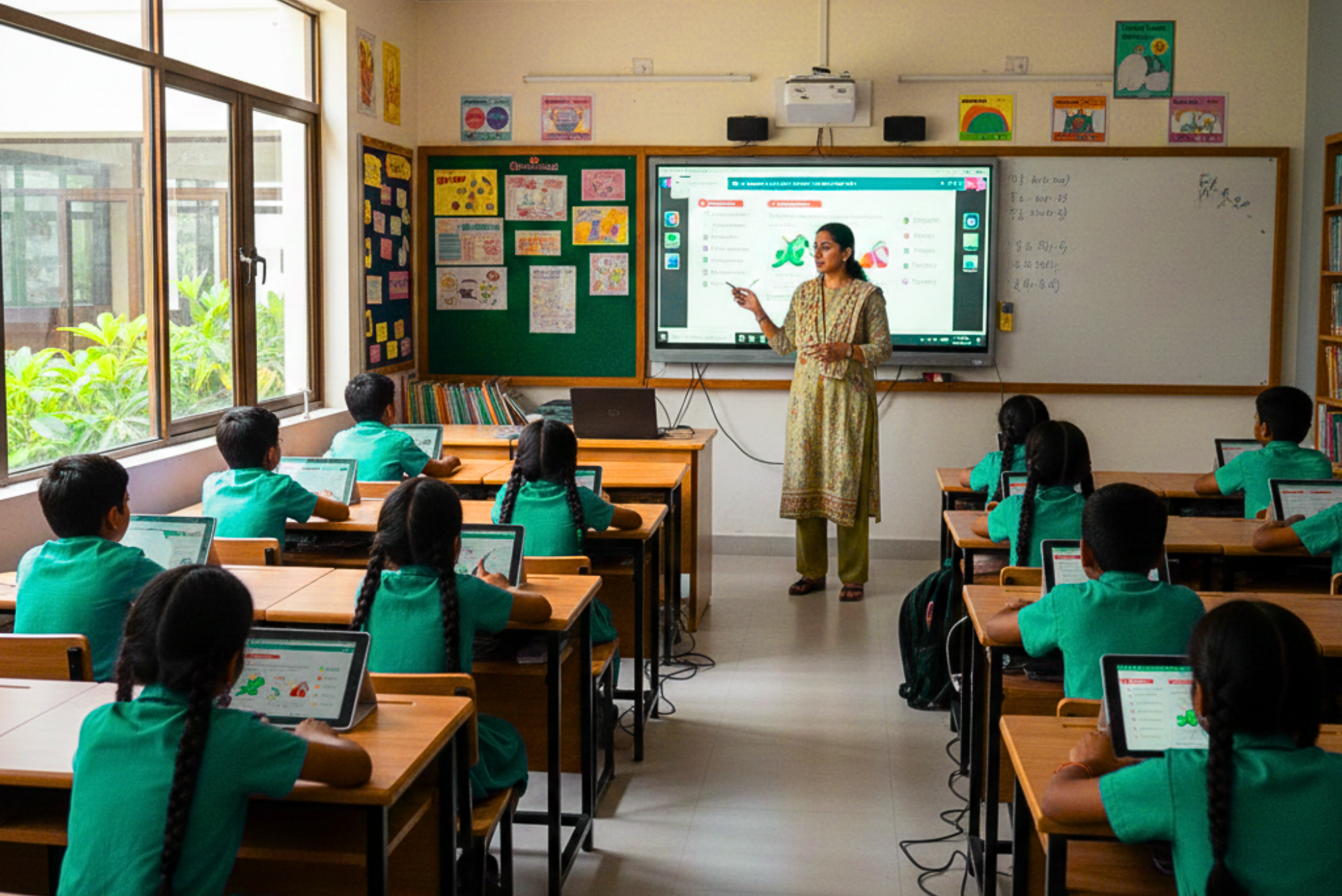
Their model layers hardware, software, and teaching methods. Teachers receive structured training; classrooms receive tablets, TV screens, and learning kits. Every lesson is mapped through a standardized curriculum that guides teachers step-by-step. LEAD’s English Language and General Awareness program helps students who start with low English proficiency build the foundational skills needed for employability.
The scale is already material: 8,500 schools, 60,000 teachers, 400 cities, and over 3.8 million students. The model doesn’t ask schools to reinvent themselves - it simply gives them a turnkey upgrade that raises the floor and the ceiling of learning outcomes.
Financial Services: Underwriting Households, Not Individuals
Credit access in rural India has long been constrained by the absence of formal data. Without credit histories, most households fall back on informal lenders. What’s notable is that financial behavior in these regions is collective. Households pool resources and depend on multiple income streams, making individual-level underwriting deeply inadequate.
Sarvagram’s insight was to conduct a “financial MRI” at the household level. By mapping formal and informal income, the stability of family businesses, spending patterns, and qualitative signals, they generate a far more accurate picture of repayment ability. Technology processes this mix of quantitative and contextual data to generate an internal credit score.
The distribution engine is hyperlocal: Sarvamitras - trusted community members - use a mobile app to onboard customers, complete e-KYC, and deliver loans at the doorstep. With 170+ branches, 150,000 households served, and an AUM of over ₹1,300 crore, the model shows how digital tools and community networks can formalize what historically lived outside the financial system.
Agriculture: Powering Farmer Collectives
Agriculture services are the fourth pillar of the Digital Village. Instead of lending to individual farmers, Samunnati works through Farmer Producer Organizations (FPOs) - collectives that buy inputs and sell outputs in bulk, giving farmers stronger bargaining power.
Their FPO-Next platform digitizes the full chain: credit access, input purchasing, and produce sales. A single FPO CEO can manage operations, secure capital, and oversee supply chain flows from one digital dashboard. It’s a full-stack agri solution designed for scale and stability.
Across healthcare, education, finance, and agriculture, the through-line is clear: digital rails paired with local touchpoints can deliver high-quality essential services to markets once considered unreachable.
The Next Wave: Location Intelligence and AI
The next decade will test whether these models can scale across the country. The services themselves are becoming standardized; the bottleneck now is how companies expand and manage rural operations. Today, expansion is often chaotic. Headquarters depend on the fragmented knowledge of local teams - knowledge that disappears with high attrition. Institutional memory is thin, planning is inconsistent, and the quality of operations varies widely across branches.
Location intelligence is set to shift that dynamic. By integrating data from maps, credit bureaus, population statistics, internal company records, etc., headquarters can identify high-potential clusters, define precise sales beats, and direct teams with far more accuracy. Instead of relying on intuition, companies can systematically reduce travel inefficiencies, improve target achievement, and lower attrition. Standardization - long missing in rural expansion - becomes achievable.
AI will amplify this shift. Vernacular tutoring can meet students at their level in their own language. Machine learning can evaluate informal financial signals with greater nuance. Instant diagnostics can reduce the load on doctors by handling screening before consultation. These are only the earliest use cases; the broader arc points to a world where geography no longer dictates access.
As Digital Villages take shape, rural markets - historically low-penetration and operationally complex - are becoming easier to serve, easier to predict, and easier to expand into. Location intelligence, AI, and digital rails make these markets more legible and more scalable, turning what used to be frontier territory into a core growth market.
For entrepreneurs and capital allocators, this is a moment to watch closely. The models gaining traction today are rewriting what is possible in rural India - and the next wave of scale will belong to those who move early.